Morning! 😃 ☕️
You know how to wish someone luck in English. "Good luck!" "Break a leg!"
Italians do it differently. Before an exam, a job interview, a first date — they send you straight into the mouth of a wolf.
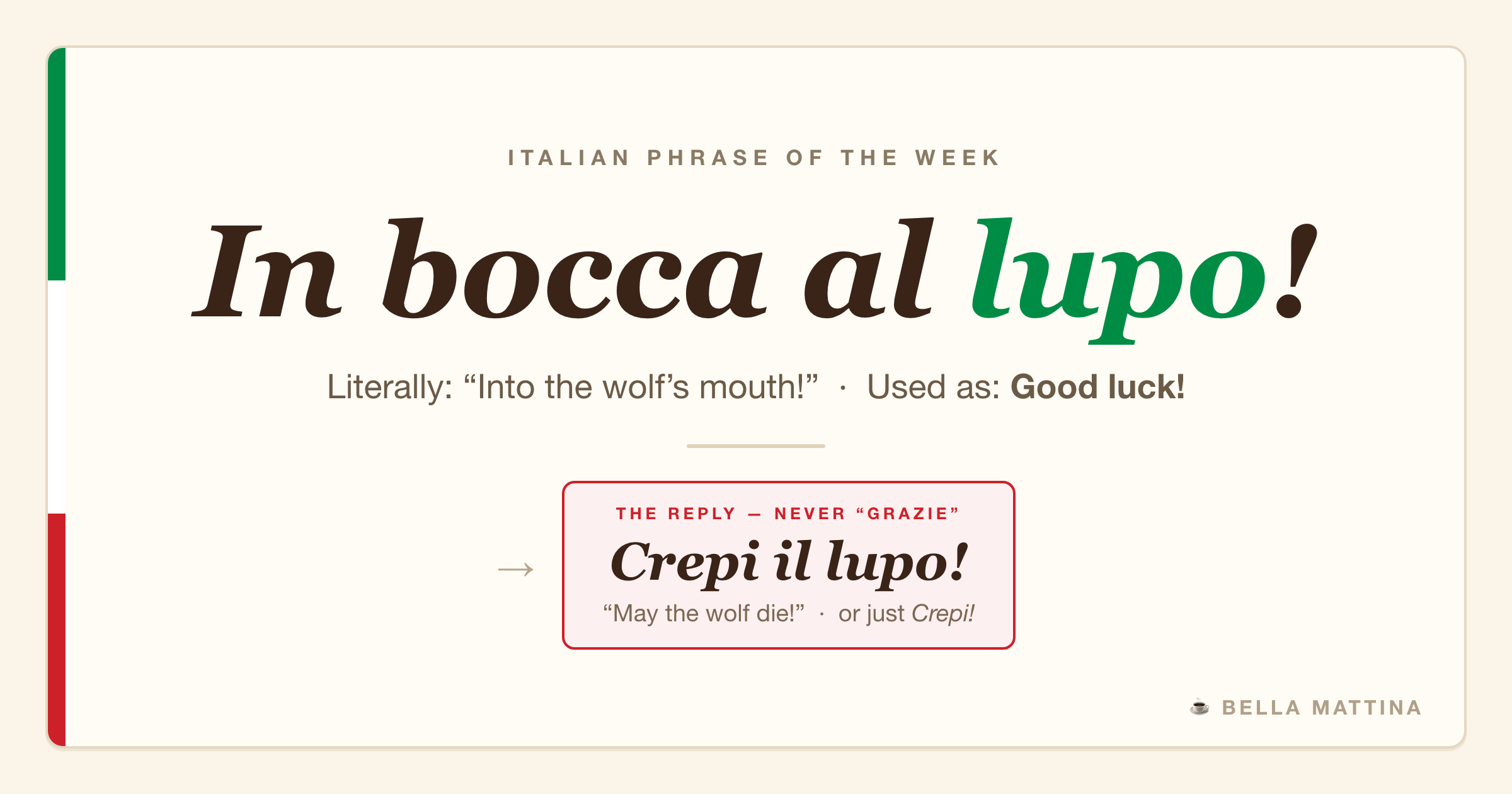
In bocca al lupo!
Literally: "Into the wolf's mouth!" And there's only one correct answer — which you'll learn today too.
This week, you're going to own it.
In today's email...
-
📱 Day 1: The full phrase - read it, feel it, start locking it in
-
🌟 Where the wolf comes from — and why nobody actually agrees
-
🗣️ How to say bocca so it doesn't sound English
-
🏃♂️ The exact moments Italians actually say this
MEMORIZE 🧠
Domani ho un esame importante. La mia amica Sofia mi sorride e dice: «In bocca al lupo!» Io rispondo: «Crepi il lupo!»
As always, the answer key and audio are at the bottom of this email.
CULTURAL MOMENT ☕
Here's the part most learners miss: the phrase comes with a mandatory reply. When someone tells you "In bocca al lupo!", you never say "grazie." The traditional answer is:
Crepi il lupo! — "May the wolf die!" (often shortened to just Crepi!)
You'll hear this exchange everywhere in Italy: outside university exam halls, before football matches, in dressing rooms, at the door before a big meeting. It works in every region, formal or informal, with your professor or your best friend. That makes it one of the safest, most powerful phrases a learner can own.
So why a wolf? Honestly — nobody knows for certain, and you should be a little suspicious of anyone who says they do. Two explanations circulate:
-
The hunters' version. The wolf's mouth was the most dangerous place imaginable, so naming the danger out loud and defying it became the wish — the same logic as "break a leg" in the theatre.
-
The she-wolf version. A mother wolf carries her cubs in her mouth — the safest place there is. Under this reading the phrase means "may you be carried safely," which makes the reply crepi look like a later addition that contradicts the original image.
Both are folk etymologies, and neither is settled. What's certain is the modern usage — and that's the part you actually need.
(Worth knowing: some animal-loving Italians now answer «Viva il lupo!» — "long live the wolf!" Both are understood everywhere. Pick "Crepi!" and you'll sound classic.)
SAY IT LIKE A LOCAL 🗣️
een BOK-ka al LOO-po · KREH-pee eel LOO-po
Three things to get right:
1. The ⟨c⟩ is a hard k. In Italian, ⟨c⟩ before a, o, u is always a /k/ sound. So bocca is BOK-ka, never "botch-a." The same rule gives you casa (KA-za) and cuore (KWO-reh).
2. The double ⟨cc⟩ is real. This is the big one. Italian double consonants aren't decorative — you genuinely hold the sound longer, and the length alone can change the word. Listen for these pairs:
- nono (ninth) vs nonno (grandfather)
- pena (pain) vs penna (pen)
- copia (copy) vs coppia (couple)
So bocca has a tiny brake inside it: BOK — ka. Rush it and an Italian ear notices immediately.
3. Stress the second-to-last syllable. BOC-ca. LU-po. CRE-pi. And every final vowel is pronounced fully — lupo ends in a clear o, not the lazy "uh" English tends to give it.
In real speech the whole wish runs together in one breath: in-BOK-kal-LOO-po.
WORD SPOTLIGHT 🔍️
Today's focus: bocca and lupo — the two words that carry the image.
Bocca means "mouth." You'll meet it constantly: acqua in bocca ("water in the mouth" — meaning keep it secret), rimanere a bocca aperta (to be left open-mouthed, amazed). Italian loves building idioms around the body, and bocca is one of its favourite building blocks.
Lupo means "wolf." The wolf runs deep in Italian culture — a she-wolf (la lupa) is said to have nursed Romulus and Remus, the legendary founders of Rome. When Italians put a wolf in a phrase, they're reaching for something ancient.
COMMON MISTAKE ⚠️
Don't answer "grazie."
It feels natural — someone wishes you well, you thank them. But thanking the wisher is said to undo the charm, and an Italian will usually correct you on the spot, with a smile: "No, no — si dice crepi!"
Watch the small words too: it's in bocca al lupo, not "in bocca il lupo." That al is a contraction of a + il, and it has to be there.
IN THE WILD 👀
Outside oral-exam rooms at Italian universities. Backstage before auditions. In the corridor before a job interview. Before a driving test, a race, a big medical appointment. Anywhere someone is about to walk into something hard.
USE IT TODAY 🏃♂️
- Say the whole exchange out loud twice — both halves, wish and reply. Your mouth needs the reps, not just your eyes.
- Hold the double cc in bocca deliberately. Exaggerate it once; it'll feel wrong and be right.
- Think of one person facing something this week. You now have exactly the right thing to say to them.
HEAR THE ITALIAN 🎧
[OWNER: native audio file — record a native Italian speaker reading the MEMORIZE paragraph ("Domani ho un esame importante…") and attach it here in Beehiiv before sending.]
Pro tip: Listen three times.
Once for general meaning.
Once following along with the text.
Once with your eyes closed, focusing purely on pronunciation and rhythm.
ANSWER KEY ✅
Domani ho un esame importante. La mia amica Sofia mi sorride e dice: «In bocca al lupo!» Io rispondo: «Crepi il lupo!»
"Tomorrow I have an important exam. My friend Sofia smiles at me and says: 'Into the wolf's mouth!' (Good luck!) I answer: 'May the wolf die!' (It will go well!)"
Today's disappeared words: None — Day 1 is always the full text. Lock it in.
See you tomorrow! — ☕ The Bella Mattina Team
There's a better way to learn.
Bella Mattina delivers one memorable disappearing Italian phrase to your inbox daily. It’s a simple, effective way to build fluency without the frustration.