Morning! 😃 ☕️
Most of it is gone now — not just the proverb, but the little scene around it.
Before you scroll: say the whole thing out loud from memory. The sentence and the saying.
Don't check. Just try.
If you got it — feel that? That's the phrase becoming yours.
In today's email...
-
📱 Day 4: Mostly blanks - your memory does the heavy lifting
-
🌟 The most Italian noun in the sentence
-
🗣️ The accent on caffè and what it's telling you
-
🏃♂️ Say it to somebody today
MEMORIZE 🧠
Voglio imparare l'____ in un mese. Mio ____ beve il suo ____ e sorride: «___ va ____, va ____ e va ____.»
As always, the answer key and audio are at the bottom of this email.
CULTURAL MOMENT ☕
The scene in our sentence is not decoration. A grandfather, a coffee, and a piece of advice delivered mid-sip is close to a national tableau.
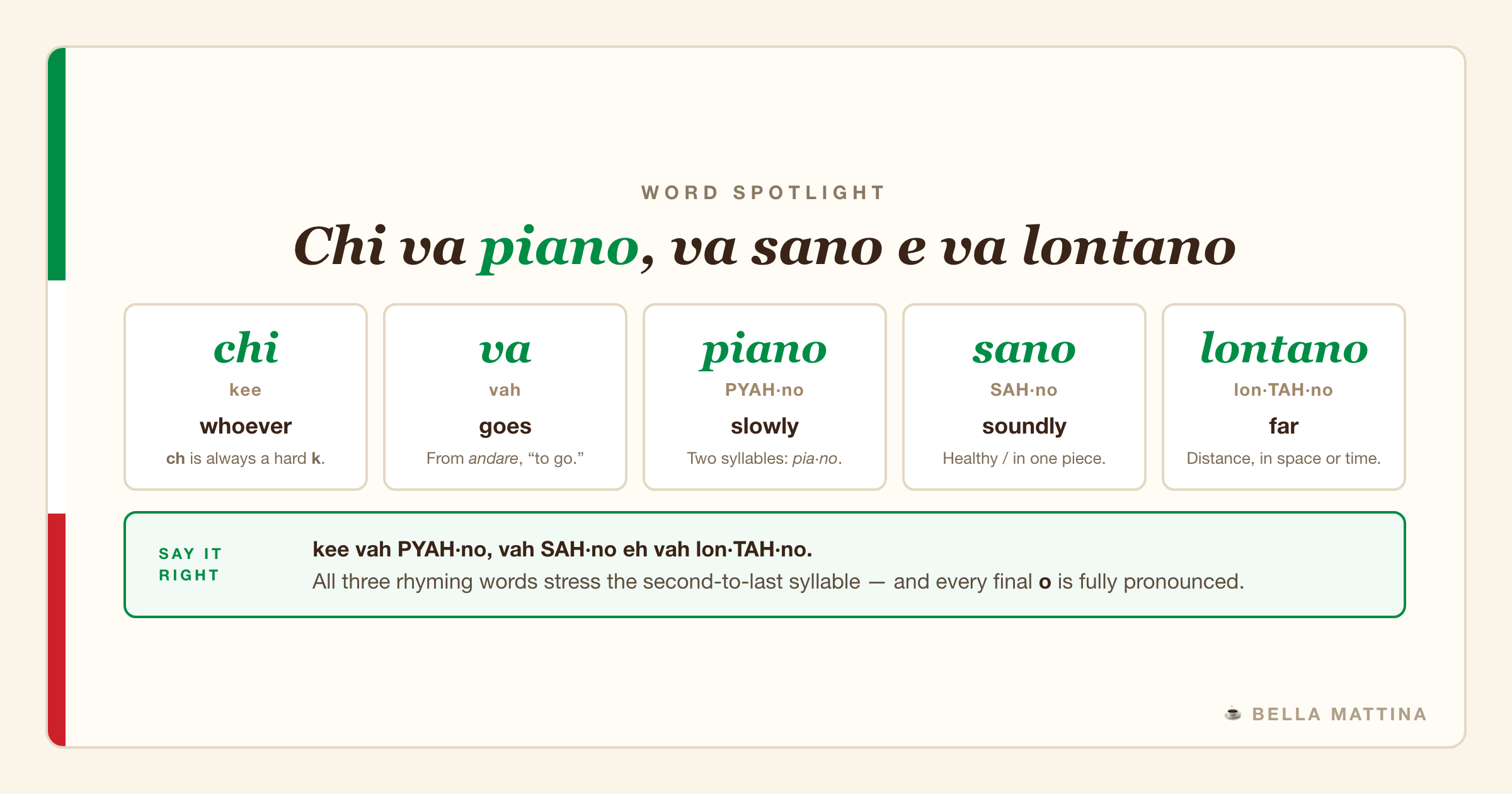
Worth knowing: un caffè in Italy means an espresso. Not a mug, not a filter — a small, strong shot, usually drunk standing at the bar in about ninety seconds. If you want something longer you ask for it by name: un caffè lungo, un americano. A cappuccino is a breakfast drink; ordering one after dinner is the single most reliable way to be identified as a tourist.
There's a nice contradiction in all this. The country that invented the ninety-second coffee is the same one that says chi va piano. Italians are perfectly happy to do a thing quickly — they just don't believe in doing a life quickly. Fast espresso, slow everything else.
WORD SPOTLIGHT 🔍️
Today's new disappeared words: italiano, nonno, caffè
Italiano — "Italian," the language and the nationality. Note the lowercase: Italian doesn't capitalise languages or nationalities the way English does. Parlo italiano. Sono italiano. And because it starts with a vowel, l'italiano elides the article — lo becomes l'.
Nonno — "grandfather" (nonna for grandmother, i nonni for grandparents). Listen for the double nn: NON-no, held. Compare nono ("ninth") with a single n — one letter, completely different word.
Caffè — "coffee," and note the double ff and the accent on the final e.
SAY IT LIKE A LOCAL 🗣️
That accent in caffè is doing a real job: it tells you the stress falls on the last syllable — kaf-FEH — which is unusual in Italian and therefore has to be marked.
This is the general rule. Italian words normally stress the second-to-last syllable, so nothing needs writing down. When the stress lands on the final syllable instead, the language marks it with an accent: caffè, città, perché, papà, virtù. Those accents aren't decoration and they aren't optional.
Say them all with the punch at the end: kaf-FEH, chit-TA, per-KEH.
COMMON MISTAKE ⚠️
Capitalising italiano. In English we write "Italian." In Italian it's italiano — lowercase, always, for both the language and the nationality. Same for inglese, francese, spagnolo.
And don't drop the accent on caffè. Written without it, the stress moves and the word stops being the word.
IN THE WILD 👀
Any Italian bar, any morning, standing up. Un caffè, per favore — and thirty seconds later you're done and back on the street.
USE IT TODAY 🏃♂️
- Say the full sentence from memory before you look. Write it down if you can — writing catches the gaps reading hides.
- Practise the double consonants: nonno and caffè. Hold them longer than feels natural.
- Order your coffee today with the phrase in your head. Piano piano.
HEAR THE ITALIAN 🎧
[OWNER: native audio file — same recording as Day 1 (the full MEMORIZE paragraph); attach in Beehiiv before sending.]
Pro tip: Listen three times.
Once for general meaning.
Once following along with the text.
Once with your eyes closed, focusing purely on pronunciation and rhythm.
ANSWER KEY ✅
Voglio imparare l'italiano in un mese. Mio nonno beve il suo caffè e sorride: «Chi va piano, va sano e va lontano.»
"I want to learn Italian in a month. My grandfather drinks his coffee and smiles: 'Whoever goes slowly, goes soundly and goes far.' (Slow and steady wins the race.)"
Today's disappeared words: italiano, nonno, caffè, chi, piano, sano, lontano
See you tomorrow! — ☕ The Bella Mattina Team
There's a better way to learn.
Bella Mattina delivers one memorable disappearing Italian phrase to your inbox daily. It’s a simple, effective way to build fluency without the frustration.