Morning! 😃 ☕️
Four words gone today.
The proverb is down to its skeleton — va… va… e va… — and you have to hang the rhymes back on it.
Close your eyes for three seconds before you scroll. Try to hear it rather than see it. The rhyme is the handle; grab that and the words follow.
That's where fluency lives.
In today's email...
-
📱 Day 3: Four blanks - only the scaffolding is left
-
🌟 What sano really means (it isn't "sane")
-
🗣️ The Italian s that turns into a z
-
🏃♂️ Rebuild it from the rhyme
MEMORIZE 🧠
Voglio imparare l'italiano in un mese. Mio nonno beve il suo caffè e sorride: «___ va ____, va ____ e va ____.»
As always, the answer key and audio are at the bottom of this email.
CULTURAL MOMENT ☕
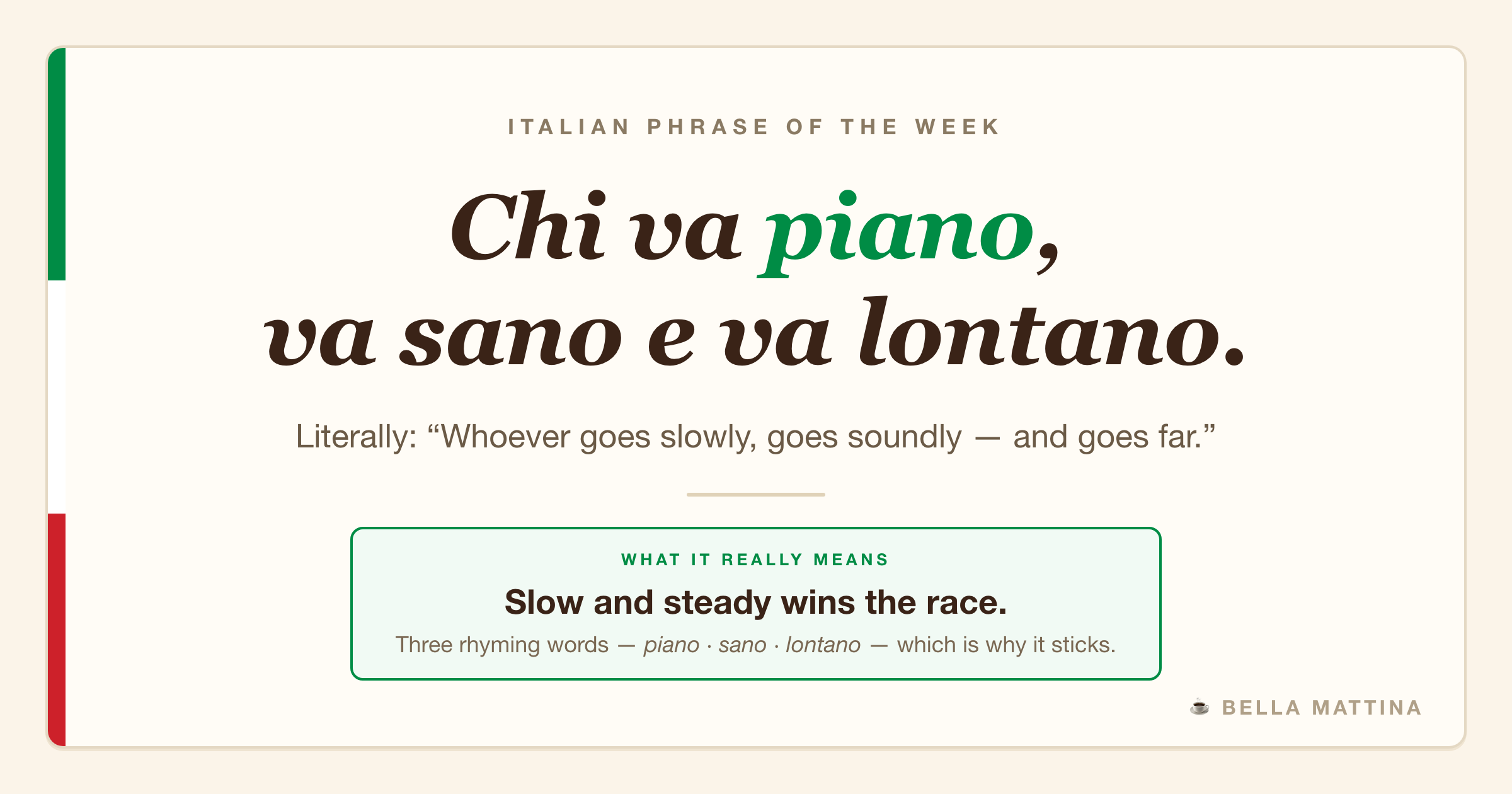
Notice the shape of this proverb: one condition, two rewards.
Go slowly, and you get two things — you arrive sano (in one piece) and you get lontano (further than the people who rushed). That's a more interesting argument than "slow and steady wins the race," which only promises the finish line.
Italian proverbs love this three-beat structure. It's built for the voice, not the page — a rhythm you can say across a table and expect the other person to finish. Try it on an Italian sometime: say "Chi va piano…" and stop. They'll complete it. Almost everyone can.
That's what it means for a phrase to be genuinely alive in a language. Not that people understand it — that they can finish it.
WORD SPOTLIGHT 🔍️
Today's new disappeared words: chi and sano
Chi — "who / whoever." Remember: kee. Beyond questions (Chi parla? — "Who's speaking?"), it builds proverbs and general truths, the equivalent of English "he who…" or "whoever…": chi cerca trova ("whoever seeks, finds").
Sano — and here's the trap. Sano does not mean "sane." It means healthy, sound, whole, undamaged: un'alimentazione sana (a healthy diet), sano e salvo ("safe and sound"). To say someone is mentally sane, Italian adds a phrase: sano di mente.
So va sano isn't "goes sanely." It's closer to "arrives in one piece" — which, once you see it, is a much better piece of advice.
SAY IT LIKE A LOCAL 🗣️
SAH-no — and pay attention to that s.
Italian s between two vowels is usually voiced, closer to an English z: casa sounds like "KA-za," cosa like "KO-za," esame like "eh-ZA-meh." But at the start of a word, before a vowel, it stays a plain hissing s — so sano is SAH-no, not "ZAH-no."
One word, two rules, and the position decides. It's the sort of small thing that separates careful Italian from approximate Italian.
COMMON MISTAKE ⚠️
Translating sano as "sane." They look like twins and they aren't. Sano = healthy / in one piece. This family of false friends is worth watching in Italian: morbido means "soft," not "morbid"; libreria is a bookshop, not a library; fattoria is a farm, not a factory.
IN THE WILD 👀
Sano e salvo — "safe and sound" — is the phrase you'll hear when someone finally gets home from a long journey. Same word, same idea: arrived undamaged.
USE IT TODAY 🏃♂️
- Rebuild the proverb from the rhyme alone: -ano, -ano, -ano. Say it before you check.
- Practise the voiced s: casa, cosa, esame — all with a z sound. Then sano, with a clean s.
- Learn one false friend today besides sano. Morbido is the fun one.
HEAR THE ITALIAN 🎧
[OWNER: native audio file — same recording as Day 1 (the full MEMORIZE paragraph); attach in Beehiiv before sending.]
Pro tip: Listen three times.
Once for general meaning.
Once following along with the text.
Once with your eyes closed, focusing purely on pronunciation and rhythm.
ANSWER KEY ✅
Voglio imparare l'italiano in un mese. Mio nonno beve il suo caffè e sorride: «Chi va piano, va sano e va lontano.»
"I want to learn Italian in a month. My grandfather drinks his coffee and smiles: 'Whoever goes slowly, goes soundly and goes far.' (Slow and steady wins the race.)"
Today's disappeared words: chi, piano, sano, lontano
See you tomorrow! — ☕ The Bella Mattina Team
There's a better way to learn.
Bella Mattina delivers one memorable disappearing Italian phrase to your inbox daily. It’s a simple, effective way to build fluency without the frustration.