Morning! 😃 ☕️
Yesterday you met the proverb.
Today, two words are gone: the first rhyme and the last one. The two ends of the little song.
Your memory has to close the gap between them.
That's the whole game — the moment you recall a word instead of re-reading it, it moves one step closer to being yours.
In today's email...
-
📱 Day 2: Two blanks - the rhyme has holes in it
-
🌟 Why piano is one of Italian's most useful words
-
🗣️ Saying lontano without swallowing the ending
-
🏃♂️ Two ways to use it today
MEMORIZE 🧠
Voglio imparare l'italiano in un mese. Mio nonno beve il suo caffè e sorride: «Chi va ____, va sano e va ____.»
As always, the answer key and audio are at the bottom of this email.
CULTURAL MOMENT ☕
Of all the words in this phrase, piano is the one that will earn you the most.
On its own, said quietly, it means slow down or keep it down: Piano! to someone driving too fast, or talking too loudly in a church. Doubled up — piano piano — it becomes one of the warmest expressions in the language: "little by little," "bit by bit," "we'll get there." An Italian teacher watching a student struggle will say piano piano the way an English speaker says you're getting there.
And then there's the other piano — the noun. A piano is a floor of a building (il primo piano, the first floor) and also a plan (un piano, a plan). Plus, of course, the instrument. Four meanings, one small word, all of them common.
Context does all the work, and you'll pick it up faster than you expect. That's how vocabulary actually grows: not one word at a time, but one word branching four ways.
WORD SPOTLIGHT 🔍️
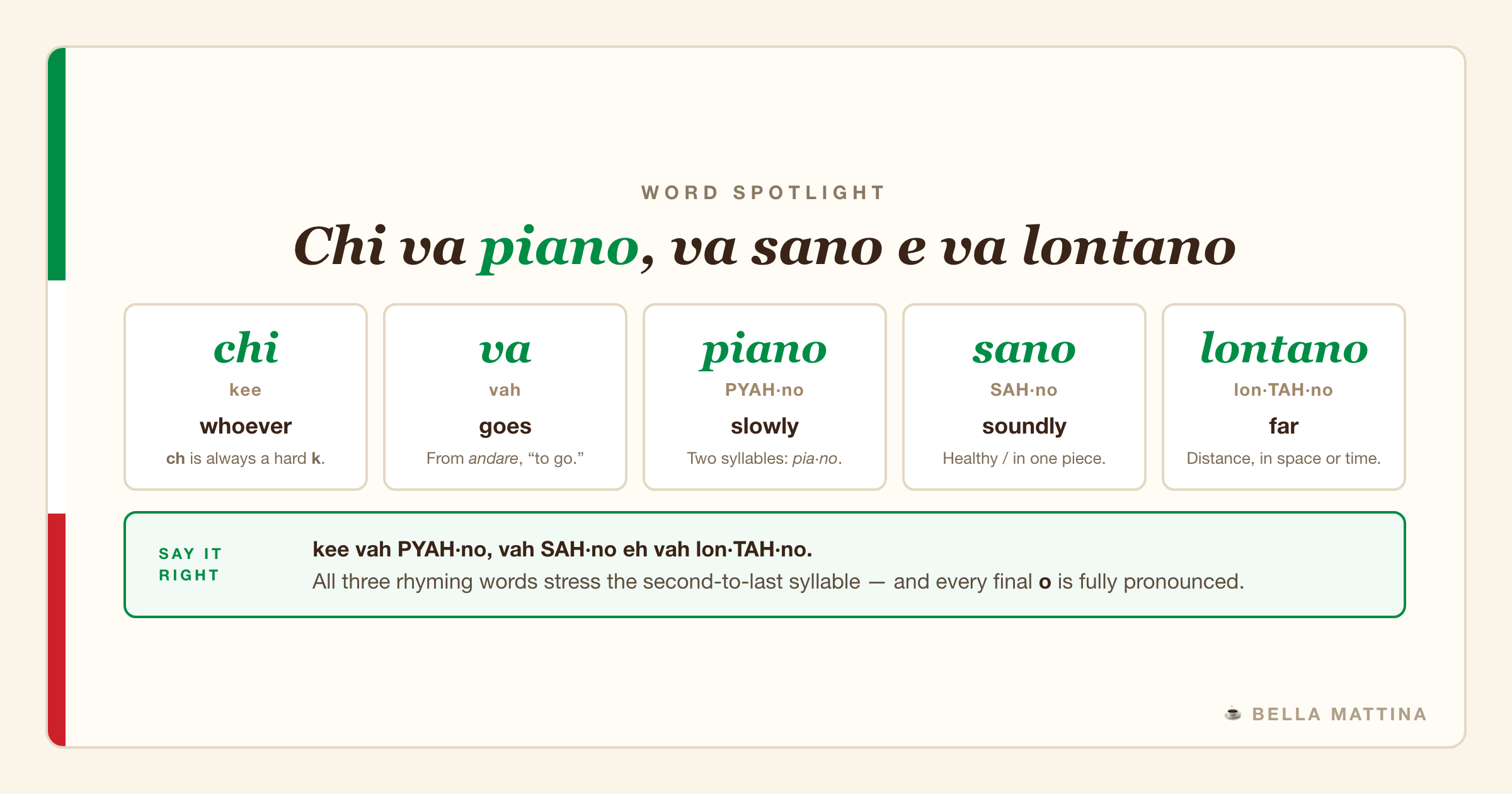
Today's disappeared words: piano and lontano
Piano — "slowly, softly." Say piano piano to mean "little by little." It's the most quietly encouraging phrase in Italian, and it's the whole philosophy of learning a phrase a week.
Lontano — "far," "distant." It works in space and in time: abito lontano ("I live far away"), un ricordo lontano ("a distant memory"). Its opposite is vicino ("near"), and the two travel together constantly: vicino o lontano.
Both end in -ano, both stress the second-to-last syllable, and that shared ending is the hinge the whole proverb swings on.
SAY IT LIKE A LOCAL 🗣️
lon-TAH-no — three syllables, all of them fully pronounced.
The trap here is English habit. In English, unstressed vowels collapse into a mumble — the ending of "Milan" or "Roman" is barely a vowel at all. Italian never does this. That final o in lontano is a real, round, open o, and it gets the same care as the stressed a before it.
Try it slowly: lon — TAH — no. Then at speed. The vowel should survive the speed.
COMMON MISTAKE ⚠️
Don't swallow the final vowel. Lontan', pian', san' — that clipped ending is the fastest way to sound foreign in Italian.
Italian words almost all end in a vowel, and speakers lean on those endings rather than dropping them. Give every last o its full weight, even when you're speaking quickly.
IN THE WILD 👀
Piano piano is everywhere: teachers, physios, grandparents, anyone helping someone do something difficult without rushing them.
USE IT TODAY 🏃♂️
- Cover the answer key and say the two missing words out loud before you scroll.
- Use piano piano once today — out loud, to yourself, about something you're learning. It's the phrase, applied.
- Say lontano five times, exaggerating the final o until it feels ridiculous. That's roughly correct.
HEAR THE ITALIAN 🎧
[OWNER: native audio file — same recording as Day 1 (the full MEMORIZE paragraph); attach in Beehiiv before sending.]
Pro tip: Listen three times.
Once for general meaning.
Once following along with the text.
Once with your eyes closed, focusing purely on pronunciation and rhythm.
ANSWER KEY ✅
Voglio imparare l'italiano in un mese. Mio nonno beve il suo caffè e sorride: «Chi va piano, va sano e va lontano.»
"I want to learn Italian in a month. My grandfather drinks his coffee and smiles: 'Whoever goes slowly, goes soundly and goes far.' (Slow and steady wins the race.)"
Today's disappeared words: piano, lontano
See you tomorrow! — ☕ The Bella Mattina Team
There's a better way to learn.
Bella Mattina delivers one memorable disappearing Italian phrase to your inbox daily. It’s a simple, effective way to build fluency without the frustration.