Morning! 😃 ☕️
There's a certain kind of advice that only sounds right in Italian.
Not shouted. Not motivational. Said slowly, over a coffee, by someone who has already seen how the fast version ends.
Chi va piano, va sano e va lontano.
"Whoever goes slowly, goes soundly — and goes far."
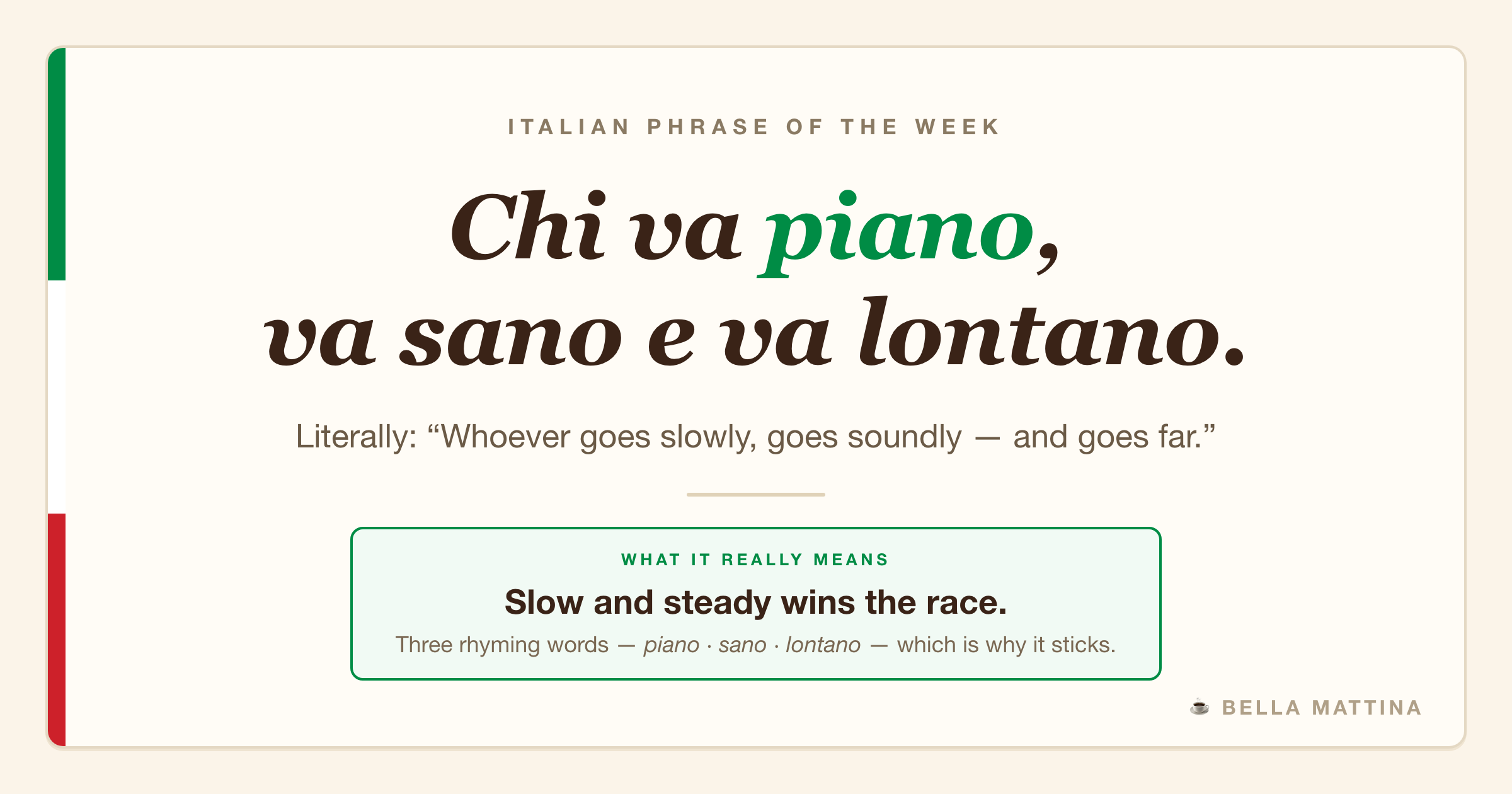
English has "slow and steady wins the race." Fine. But listen to the Italian: piano · sano · lontano. Three rhymes in one breath. It isn't a lesson, it's a little song — which is exactly why every Italian knows it by heart.
This week, you're going to own it.
In today's email...
-
📱 Day 1: The full phrase - read it, feel it, start locking it in
-
🌟 Why Italians actually mean this one
-
🗣️ The ⟨ch⟩ rule that fixes half your Italian pronunciation
-
🏃♂️ Where you'll hear it in real life
MEMORIZE 🧠
Voglio imparare l'italiano in un mese. Mio nonno beve il suo caffè e sorride: «Chi va piano, va sano e va lontano.»
As always, the answer key and audio are at the bottom of this email.
CULTURAL MOMENT ☕
This is a proverbio — and Italy takes its proverbs seriously. They're the compressed opinions of a lot of people over a very long time, and this one is about as widely known as a phrase can get: your barista knows it, your friend's grandmother knows it, and so does every child who has ever been told to stop running.
It usually arrives as gentle pushback. Someone announces a plan that's too fast — learn a language in a month, renovate the kitchen in a weekend, get fit by August — and someone older says it, not unkindly, into their coffee.
There's a longer, darker version that gets quoted for effect: «Chi va piano va sano e va lontano; chi va forte va alla morte.» — "whoever goes hard, goes to their death." You don't need to use it. But if you hear the second half, now you know it's the same proverb, wearing its serious face.
And there's a reason it belongs in this newsletter. One phrase a week is not a slow way to learn Italian. It's the way that still works in a year.
SAY IT LIKE A LOCAL 🗣️
kee vah PYAH-no, vah SAH-no eh vah lon-TAH-no
1. ⟨ch⟩ is a hard k. Always. Chi is kee — never "chee," never "shee." Italian uses that h purely to keep the c hard before i and e: chi, che, chiave, perché. Learn this one rule and a whole category of learner mistakes disappears.
2. Piano is two syllables, not three. PYAH-no. The i and a glide together into a single sound — pia, not "pee-ah." Same in piatto, piede, più.
3. Stress the second-to-last syllable. PIA-no. SA-no. lon-TA-no. Three rhymes, three identical landings — that regular beat is the whole charm of the phrase, and it's what makes it stick in your mouth.
Say the last three words as a chant: PYAH-no… SAH-no… lon-TAH-no. You'll never lose it.
WORD SPOTLIGHT 🔍️
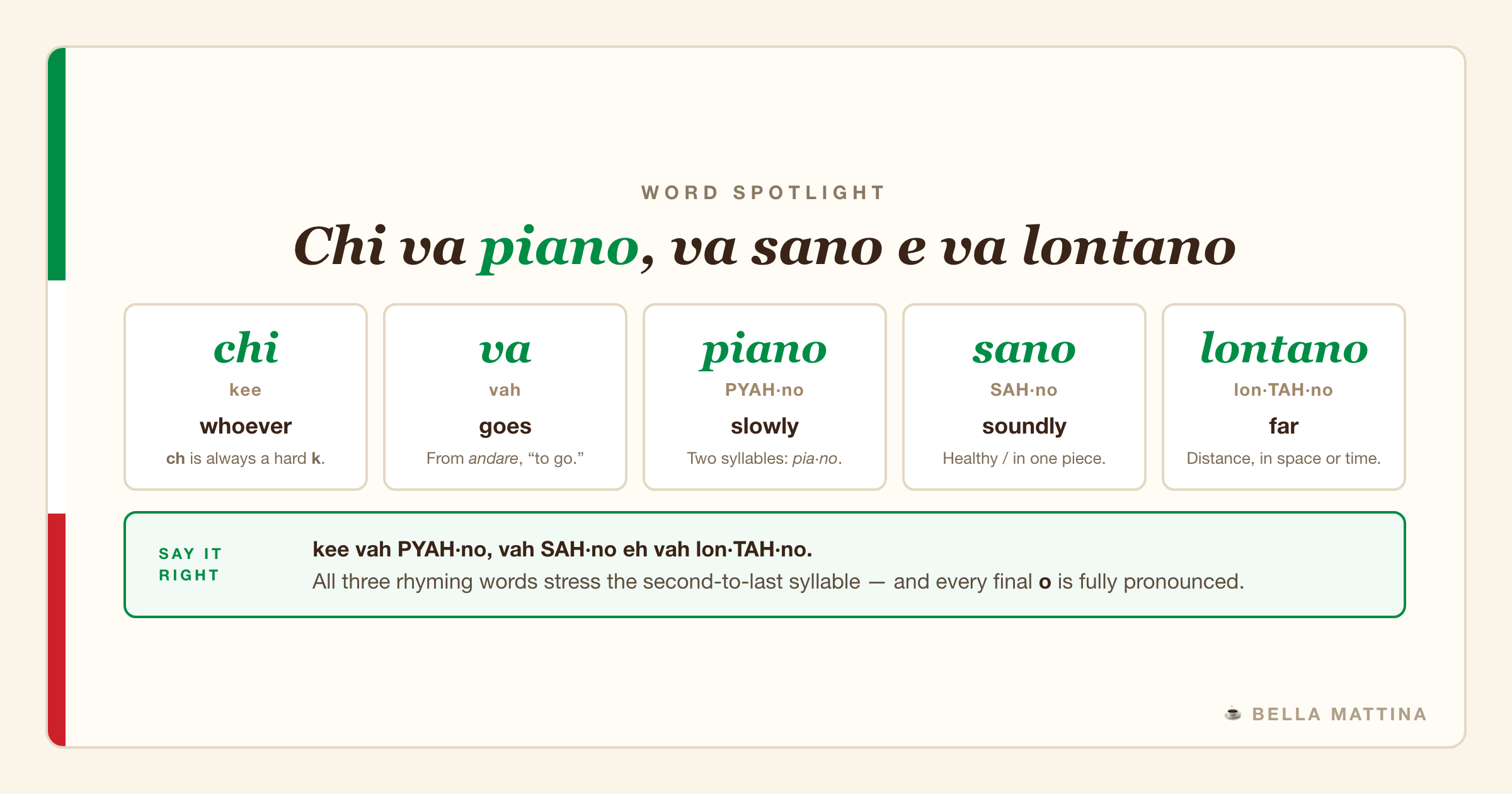
Chi means "who" or "whoever." It opens questions (Chi è? — "Who is it?") and, as here, whole proverbs: chi + verb = "the person who…". Italian loves this shape — chi dorme non piglia pesci, "whoever sleeps catches no fish."
Va is "goes" — from andare, one of the most irregular and most useful verbs in the language: io vado, tu vai, lui/lei va, noi andiamo, voi andate, loro vanno. You'll use it every single day.
Piano means "slowly" or "softly" here. Yes — the same word as the instrument, and for a good reason: the piano was originally the pianoforte, the keyboard that could play both soft (piano) and loud (forte). Italian gave the world its music vocabulary, and this is a piece of it hiding in an everyday proverb.
COMMON MISTAKE ⚠️
Don't read chi with an English "ch." This is the single most common mispronunciation of this phrase, especially for English and Spanish speakers, where ⟨ch⟩ makes a "tch" sound. In Italian it never does. kee.
IN THE WILD 👀
At the bar, when you order too much. From a parent when you take the stairs two at a time. In any conversation where someone is about to do something in half the time it takes.
USE IT TODAY 🏃♂️
- Say the phrase out loud three times, chanting the rhyme: piano, sano, lontano.
- Practise the ⟨ch⟩ rule on four words: chi, che, chiave, perché. All hard k.
- Find one thing you're currently rushing. Say the proverb at it. That's how Italians use it anyway.
HEAR THE ITALIAN 🎧
[OWNER: native audio file — record a native Italian speaker reading the MEMORIZE paragraph ("Voglio imparare l'italiano in un mese…") and attach it here in Beehiiv before sending.]
Pro tip: Listen three times.
Once for general meaning.
Once following along with the text.
Once with your eyes closed, focusing purely on pronunciation and rhythm.
ANSWER KEY ✅
Voglio imparare l'italiano in un mese. Mio nonno beve il suo caffè e sorride: «Chi va piano, va sano e va lontano.»
"I want to learn Italian in a month. My grandfather drinks his coffee and smiles: 'Whoever goes slowly, goes soundly and goes far.' (Slow and steady wins the race.)"
Today's disappeared words: None — Day 1 is always the full text. Lock it in.
See you tomorrow! — ☕ The Bella Mattina Team
There's a better way to learn.
Bella Mattina delivers one memorable disappearing Italian phrase to your inbox daily. It’s a simple, effective way to build fluency without the frustration.